HY4 Flash in depth: low-cost everyday AI, tested on seven real tasks
Official specifications, pricing, WorkIndex and user blind tests meet seven TOKRACE tasks: web design, Blender modeling, cycling-pelican animation, charts and image understanding.
Updated: 2026-11-17
TOKRACE · 2026-11-17 · Official data and hands-on work
HY4 Flash has a straightforward appeal: lower the cost of everyday AI while retaining coding, image understanding and tool use. Tencent launched it on November 16 with a listed input price of CNY 0.5 per million tokens.
We gave it seven tasks. The packing-list page has a complete visual design and working add, toggle and delete actions. Chart values are correct, and all five image differences were found. The handheld and underwater laundromat are usable 3D artifacts. Pelican feet intersect other parts, washer components protrude beyond the drums, and the exploded structure and animation wrap still have flaws.
Together, the official data and these artifacts show a clear profile: a low-priced model that can carry out everyday production tasks, with strengths in web presentation and basic image reading, and weaker structural and motion relationships.
1. A model for everyday work
HY4 Flash has 224B total parameters, including 64B Engram parameters, with 12B active. Tencent positions it for office work, simple frontend pages, search and tool operation. Repeated edits and recurring document tasks make both price and waiting time matter in daily use. Tencent announcement
| Specification | HY4 Flash |
|---|---|
| Total / active parameters | 224B / 12B |
| Context window | 1M tokens |
| Maximum input / output | 960K / 64K tokens |
| Inputs | Text and images |
| Workflow features | Reasoning, structured output, function calling and caching |
Long context, vision and tools allow a model to read material, interpret a chart and produce a page or file. Tencent Cloud’s model catalog lists these capabilities. Our web, chart and image-difference tasks exercise several of them.
2. Price and speed across the workflow
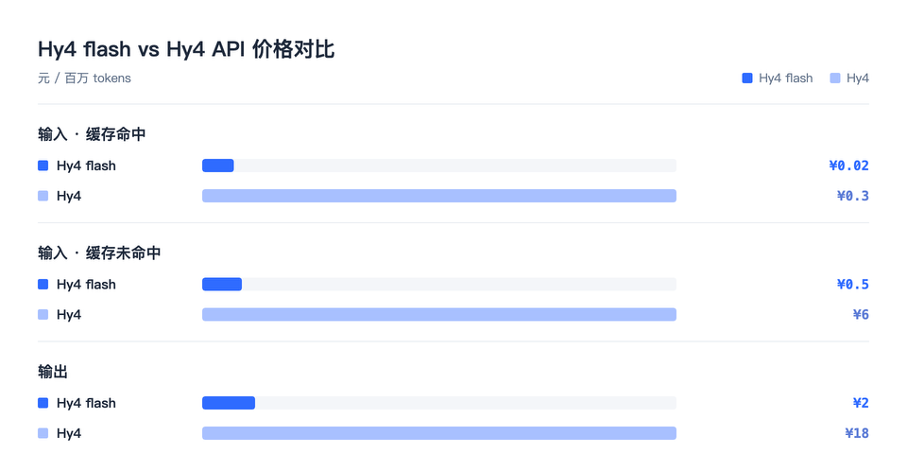
Tencent Cloud lists HY4 Flash at CNY 0.5 per million input tokens, CNY 2 per million output tokens and CNY 0.02 per million cached input tokens. HY4 is listed at CNY 6, 18 and 0.3 respectively. Cached input pricing matters particularly when successive turns reuse the same material. Tencent Cloud TokenHub
Tencent describes hybrid attention, LatentMoE and Engram, a KV cache one-sixth the size of HY4’s, shorter task outputs after post-training, and inference optimizations including quantization. It reports decoding above 150 tokens/s. Price, output volume and execution time all contribute to the cost of a completed task. Tencent announcement
3. Measuring practical work
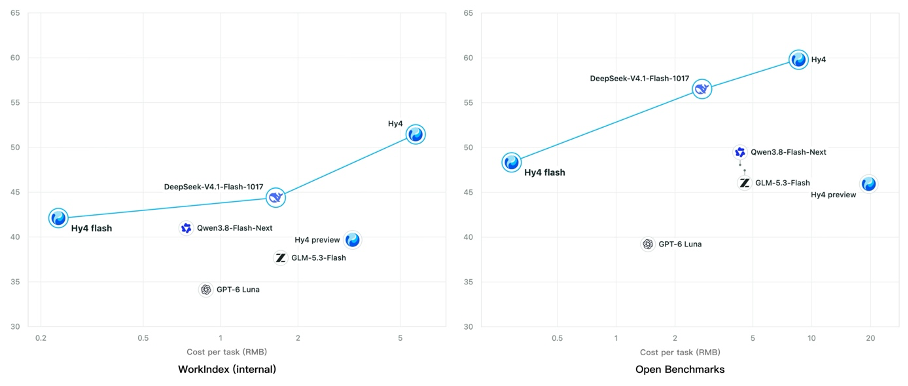
Tencent built WorkIndex around typical WorkBuddy tasks: creating and editing slides, collaborative writing, document editing, spreadsheet repair, audio/video processing and visual understanding. Revising a presentation, fixing a spreadsheet or processing a media file are concrete examples of the work it targets.
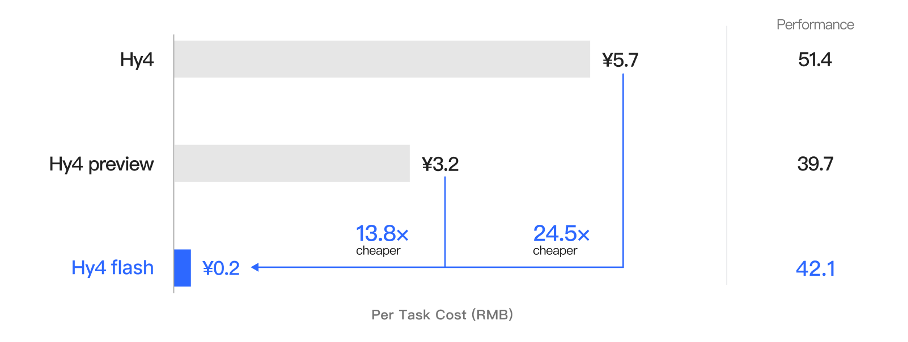
The official chart gives HY4 Flash a WorkIndex score of 42.1, compared with 39.7 for HY4 preview and 51.4 for HY4. Displayed task costs are approximately CNY 0.2, 3.2 and 5.7, respectively. Flash pairs a slightly higher score than preview with a much lower task cost.
4. A 259-task blind evaluation
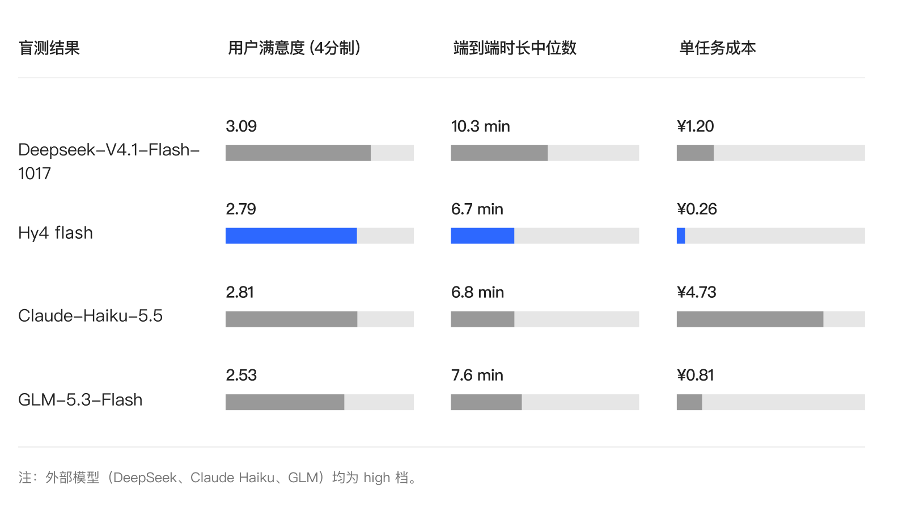
Tencent’s blind evaluation involved 85 internal WorkBuddy users, 259 tasks and 27 categories. HY4 Flash scored 2.79 for satisfaction, close to Claude Haiku 5.5’s 2.81. Median end-to-end times were 6.7 and 6.8 minutes. Cost separates them more sharply.
| Model | Satisfaction / 4 | Median time | Cost per task |
|---|---|---|---|
| HY4 Flash | 2.79 | 6.7 min | CNY 0.26 |
| Claude Haiku 5.5 | 2.81 | 6.8 min | CNY 4.73 |
| DeepSeek-V4.1-Flash-1017 | 3.09 | 10.3 min | CNY 1.20 |
| GLM-5.3-Flash | 2.53 | 7.6 min | CNY 0.81 |
Flash’s task cost in this official evaluation is about one-eighteenth of Haiku 5.5’s. DeepSeek has the highest satisfaction score. Flash combines shorter execution time, satisfaction near Haiku and lower spending.
5. Our tests: a polished, working packing list
Tencent names simple frontend work as a target use case. Our packing-list task makes that ability tangible: an off-white background, dark green buttons, clear hierarchy and spacing form a complete small utility. Visual finish is this task’s clearest strength.
The interactions work too. We added 雨伞 (umbrella), checked 充电器 (charger) and deleted 相机 (camera). Blank names were rejected, and Space toggled the checkbox. Neither desktop nor the 390-pixel mobile layout overflowed horizontally. Reloading restored the original three items.
6. Handheld: a strong exterior, a rougher exploded structure
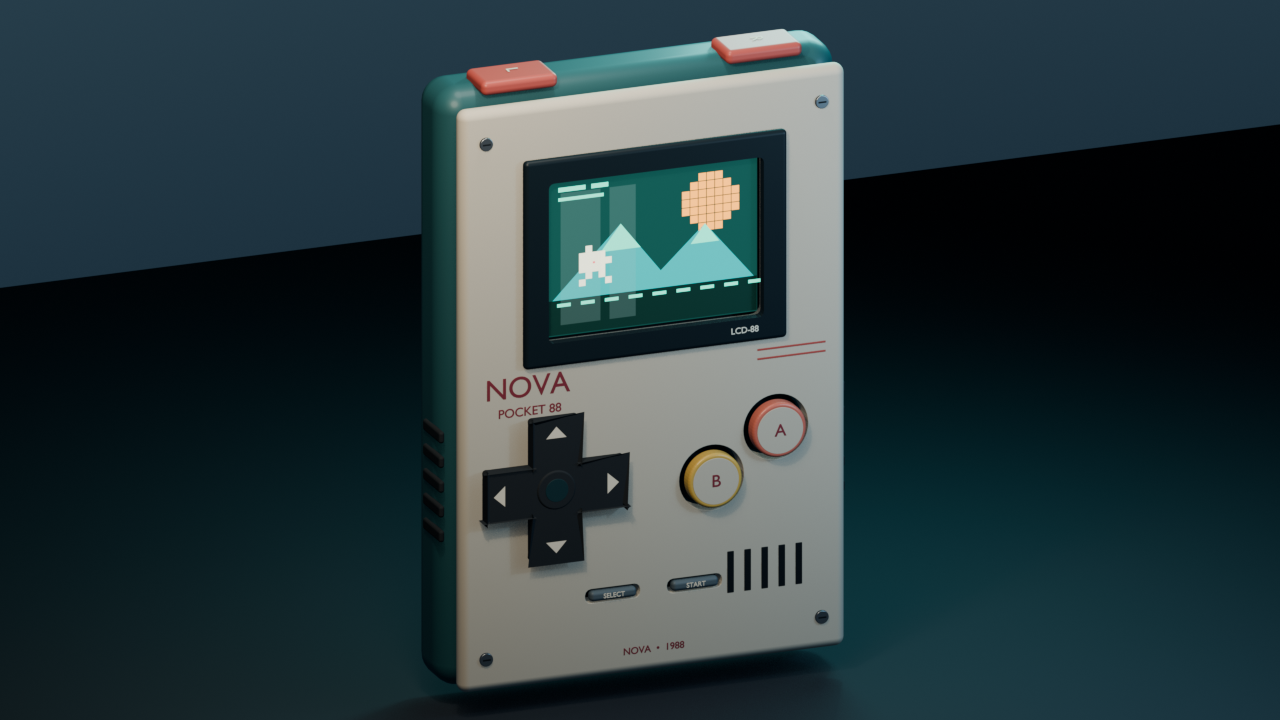
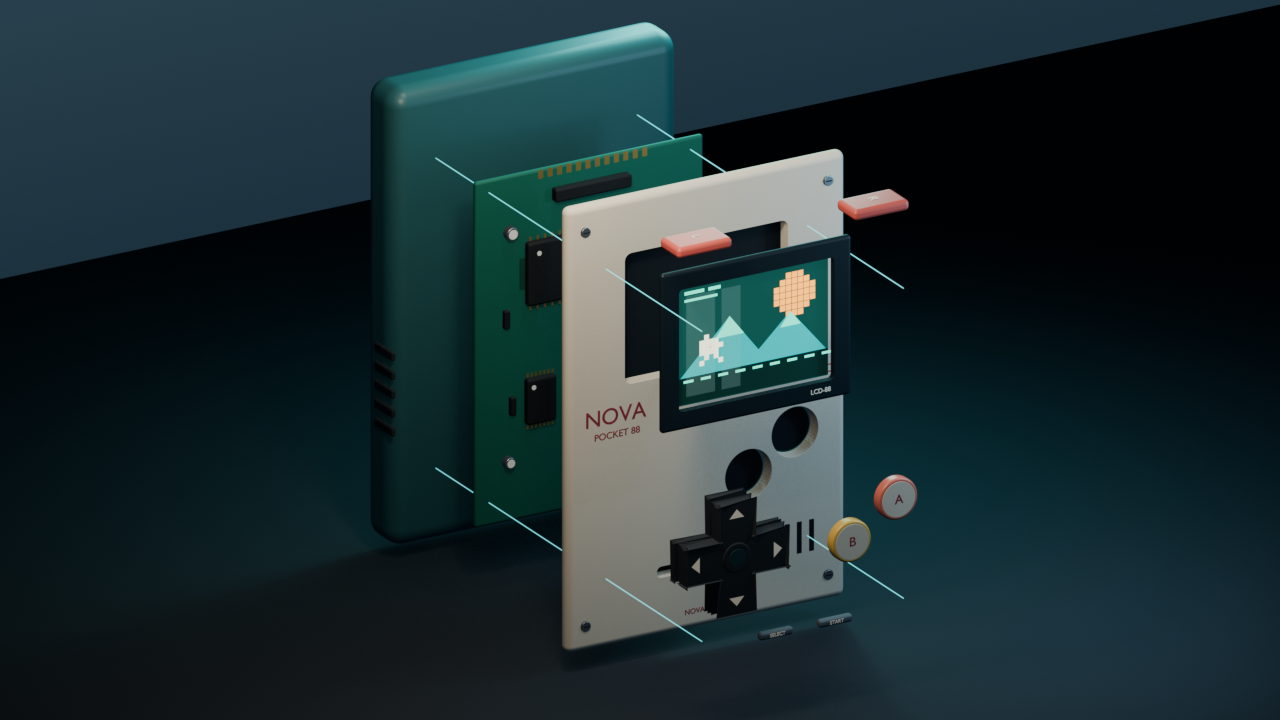
The retro handheld combines teal and off-white casing, colored controls and a pixel-style screen. Materials, lighting and color give the assembled product a distinct finish. It delivered assembled and exploded Blender projects plus two 1280 × 720 renders.
The exploded image separates the rear shell, circuit board, front panel, display and controls, and both projects reopen for editing. The assembly relationships in the exploded view remain rough. Our earlier assessment carries through: exterior finish is a strength; the internal structure is less convincing.
7. Underwater laundromat: a complete scene with awkward details
This Web3D scene is richly populated: three washers beneath a sign, with jellyfish, fish, bubbles and seaweed establishing the underwater setting. Dragging moves the camera, and the scene also works from behind, giving it real spatial depth.
The problems are in the relationships between parts. Propeller-like washer components protrude outside the drums, undermining the impression of objects tumbling inside. At the twelve-second wrap, moving elements also jump in position. The scene is built; the washer internals and loop transition need further work.
8. Still pelican: drawn, but with faulty foot placement
The still image uses a pale blue sky, distant hills and a sandy road. The white pelican, long bill and orange throat pouch are recognizable. Both wheels, the frame, chain, handlebar and pedals fit within the 1200 × 800 SVG canvas.
Foot placement undermines the drawing. Feet, frame and pedals have confused front-to-back relationships and intersect. The elements are present, but the riding pose is wrong—the reason our hands-on review judged this task a failure.


9. Animated pelican: rotating wheels, persistent intersections
The animated version switches to a red frame and follows the requested 800 × 600 format and four-second loop. Spokes and crank rotate, and the legs alternately bend and extend. There is no obvious jump near the loop boundary.
Animation does not resolve the pose. Feet and frame still intersect, and local motion relationships look awkward. This task shows both sides of HY4 Flash: it can organize an SVG animation, while fine relationships between body and mechanism remain weak.

10. Chart: correct values, too many colors
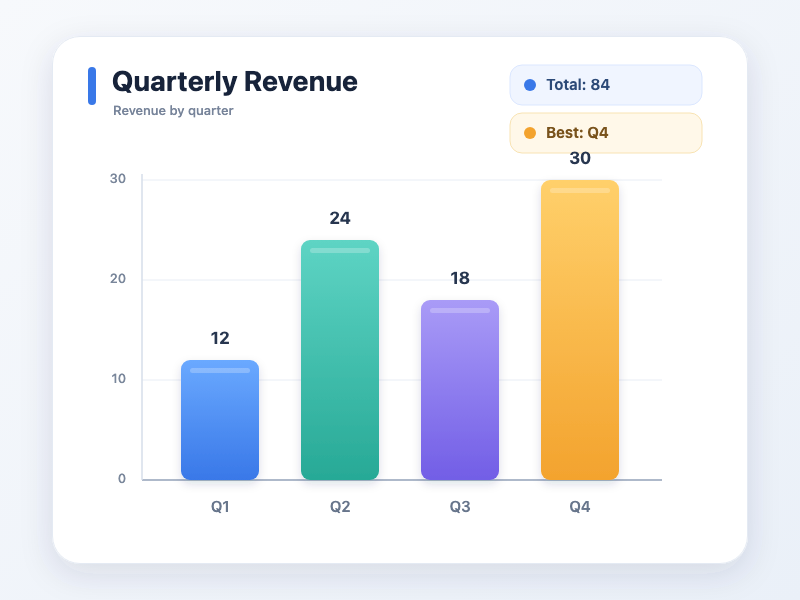
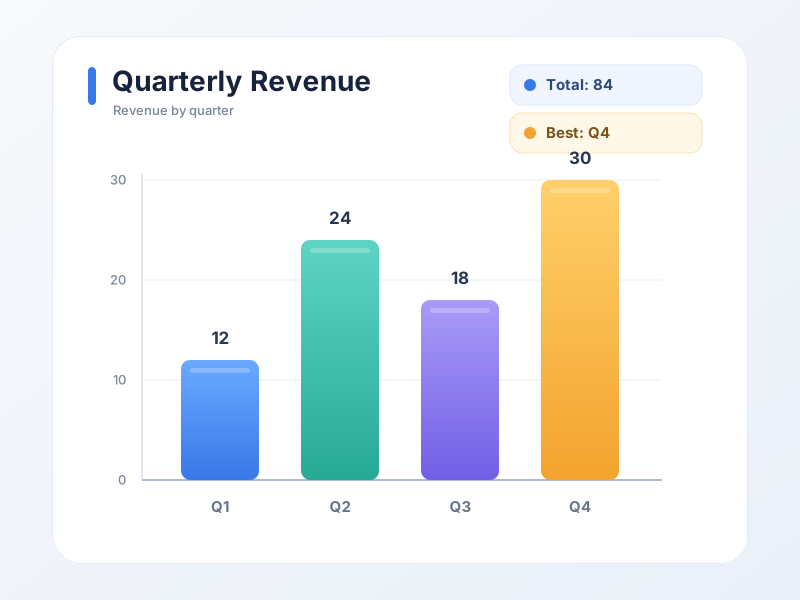
The quarterly values are 12, 24, 18 and 30. HY4 Flash uses proportional bar heights and a shared baseline. The total is correctly shown as 84, and Q4 is identified as the highest quarter.
The chart has a finished card design, but the four bars use many colors. For a simple comparison of heights, that palette adds visual burden. The data is right; the presentation could be more restrained.
11. Image understanding: all five differences found
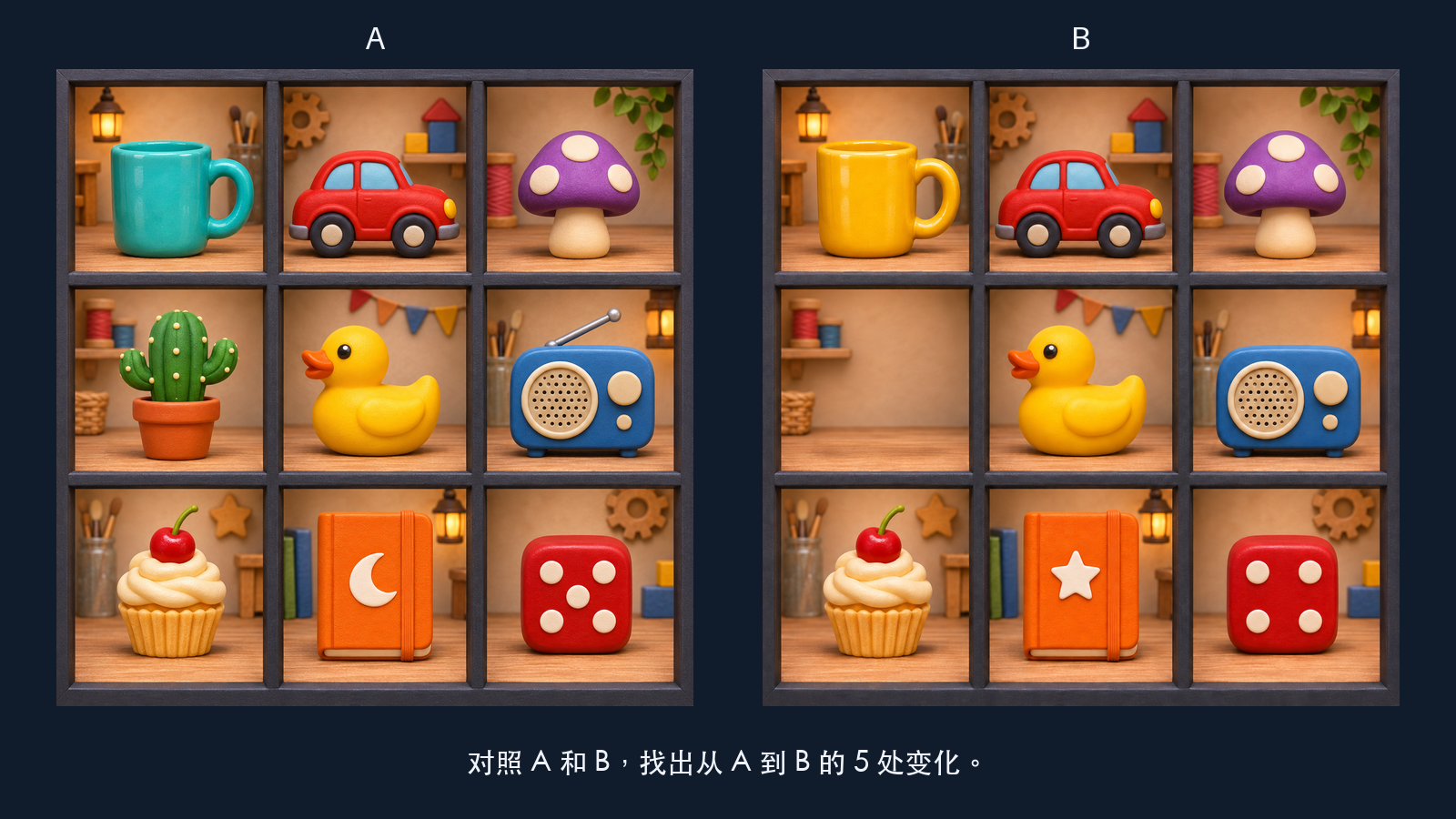
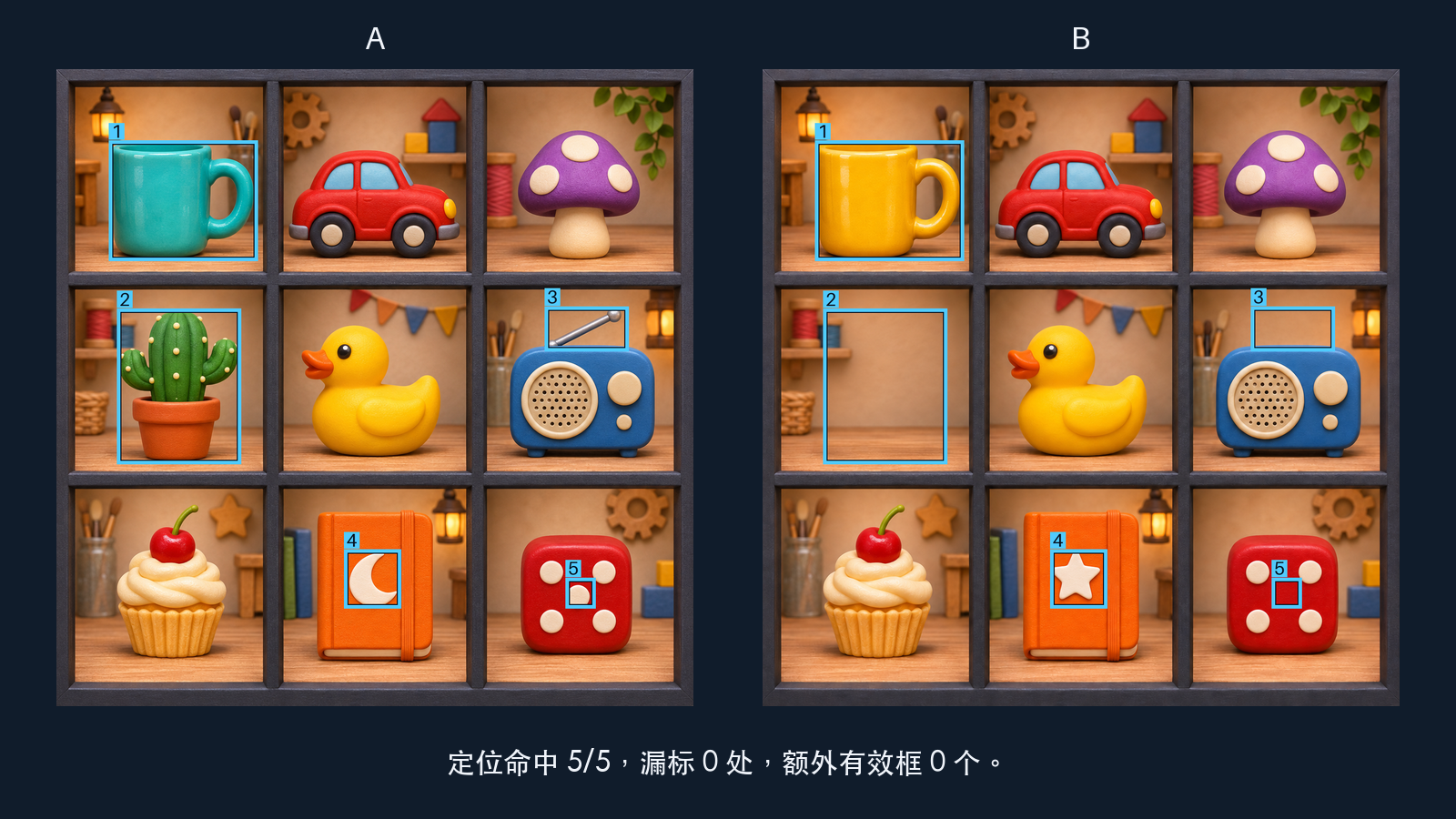
The image-difference task gives a clear result: all five changes were found, with no omissions or extra regions. The mug changes from teal to yellow, the cactus and pot disappear, the radio antenna disappears, the notebook crescent becomes a star, and the die changes from five pips to four.
Locations and descriptions are both correct, including the direction of each change. Reading specific visual changes and returning them as structured results worked in this task.
12. Where HY4 Flash fits
Taken together, the official positioning and our artifacts make HY4 Flash worth trying for small webpages, checklist utilities, basic charts, image localization and material organization. Working frontend interactions, correct chart values and five correct visual differences support those uses. For 3D scenes and character animation, treat the result as an editable starting point and spend the next pass on placement, occlusion and movement.
Developers can call hy4-flash through Tencent Cloud TokenHub using OpenAI Chat Completions, Responses or Anthropic Messages. The official guide provides examples.
We ran workbuddy/hy4-flash through WorkBuddy / Magpie on November 16, 2026, giving the model browser, Blender, file and image tools. Five main tasks ran at concurrency two in about 7 minutes 15 seconds; the two pelican tasks took about 1 minute 59 seconds. These times include tools and rendering. Original artifacts, source downloads and task records are on the seven-task evaluation page.
HY4 Flash can already turn a range of everyday tasks into work that opens, runs and remains editable. Its low list price broadens where it can be used; the final quality depends on how precisely the task requires structures and motion to fit together.
Sources
Tencent’s HY4 Flash announcement
Tencent Cloud TokenHub: model description and CNY list prices
Tencent Cloud model catalog: context and capabilities
Hy API guide: protocols and examples
Seven-task evaluation and downloads · Our earlier hands-on commentary