Gemini 4 Hydrogen Writing Review: Why the Prose Feels More Human
A dry umbrella, overseas feedback and three Chinese business drafts reveal where Hydrogen’s voice works—and where GPT leads on whole-draft editing.
Updated: 2026-11-18
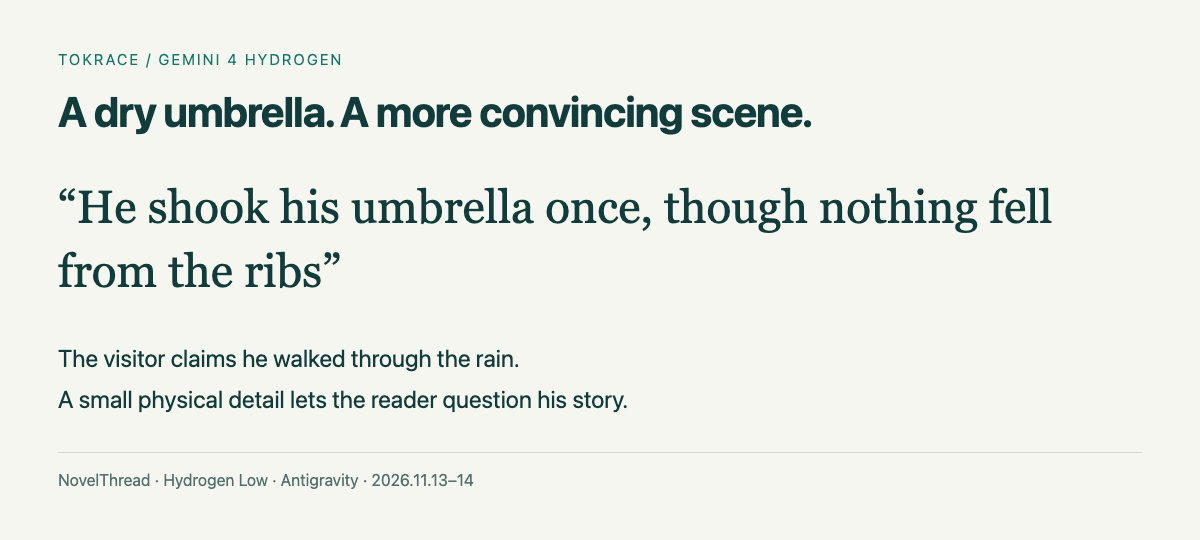
A visitor walks in claiming he came through the rain. He shakes his umbrella, yet no water falls. The reader is already suspicious. The writer can leave that inference to us.
That small moment captures a change in Hydrogen’s writing: details carry information, and characters can speak from a clearer point of view. Business writing adds another test: maintaining the facts across an entire piece.
Good prose knows when to stop
The umbrella comes from NovelThread’s local rewrite test using Hydrogen Low in Antigravity. The physical evidence contradicts the visitor’s account, creating subtext through an object.
Prose feels human when information arrives with purpose. The writer chooses when to offer a clue and when to let the reader complete the thought. Removing fashionable punctuation cannot create that effect on its own. A well-placed action can.
The praise centers on character and voice
In a Reddit writing discussion, users praise distinct character viewpoints and motives. Others in the same thread find that characters become too considerate during conflict. Both reactions ask whether a character responds as an individual.
If everyone speaks with the same careful, complete and accommodating voice, personality disappears. An angry person will not protect everyone’s feelings in every line. A hesitant person will not explain every motive neatly. Withheld information, misunderstandings and stubborn opinions can give a character a life of their own.
Google’s launch post emphasizes tone, format and specific instructions. Babbily reports a concrete adoption decision: after internal tests, it routed moderately difficult emails, posts and short documents to Hydrogen. Fewer revisions on ordinary work can be enough to change a product’s routing.
Which tasks put it ahead of GPT?
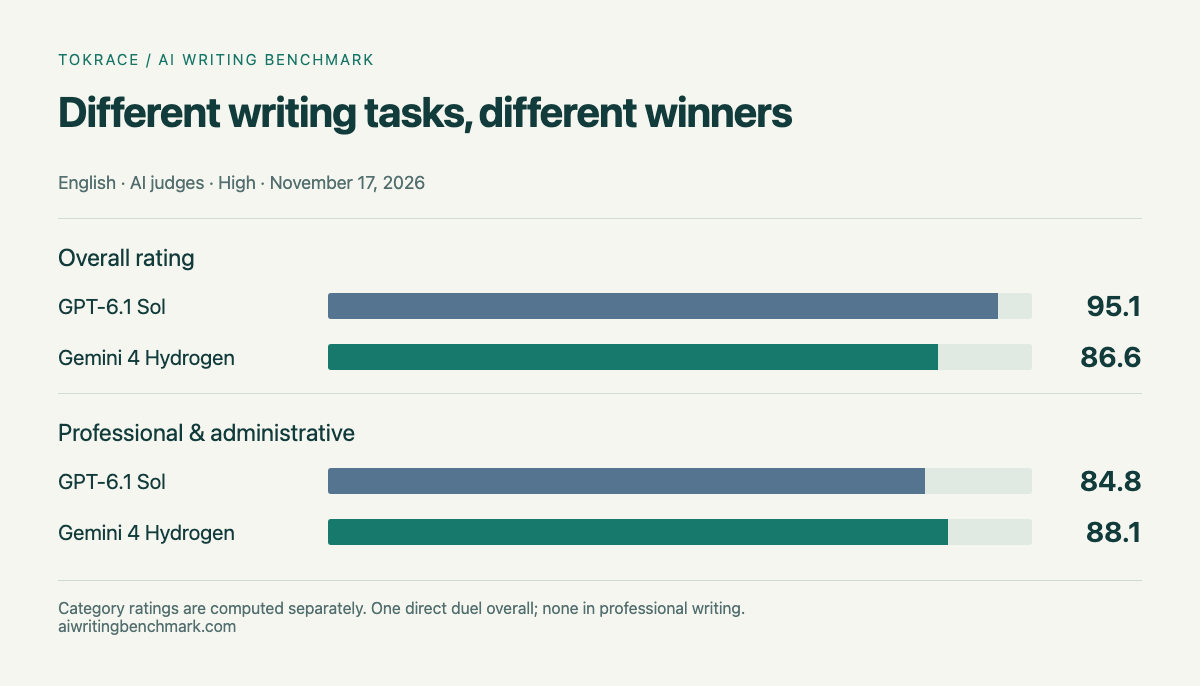
The November 17 AI Writing Benchmark compares High settings on English prompts with anonymous AI judges. Hydrogen scores 88.1 for professional and administrative writing versus GPT‑6.1 Sol’s 84.8; overall ratings are 86.6 and 95.1. There is one direct duel, with none in the professional category.
On Every’s 12 real editorial tasks, Hydrogen averages 51%–57% across two runs; GPT‑6 Astra reaches 89%. Hydrogen twice misses an opening that expands an OpenAI-only token leaderboard into a company-wide claim about all AI use.
A sentence’s accuracy may depend on a caption twenty lines later. Editors keep track of names, dates, samples and statistical scope throughout a document. They will sacrifice a more striking sentence to preserve one essential qualification. That is a different skill from producing an appealing paragraph.
Business analysis: a clear argument, with drifting numbers
On November 17, we gave Hydrogen separate fixed source briefs for three Chinese forms: business analysis, a profile and an opinion essay. The business draft links platform activity, developer research and code review into an argument: as code generation gets easier, scarce work moves toward verification, debugging and decisions.
It distinguishes research years, preserves statistical intervals that cross zero and initially explains why commit counts do not measure development efficiency. Later, the meaning of the numbers changes.
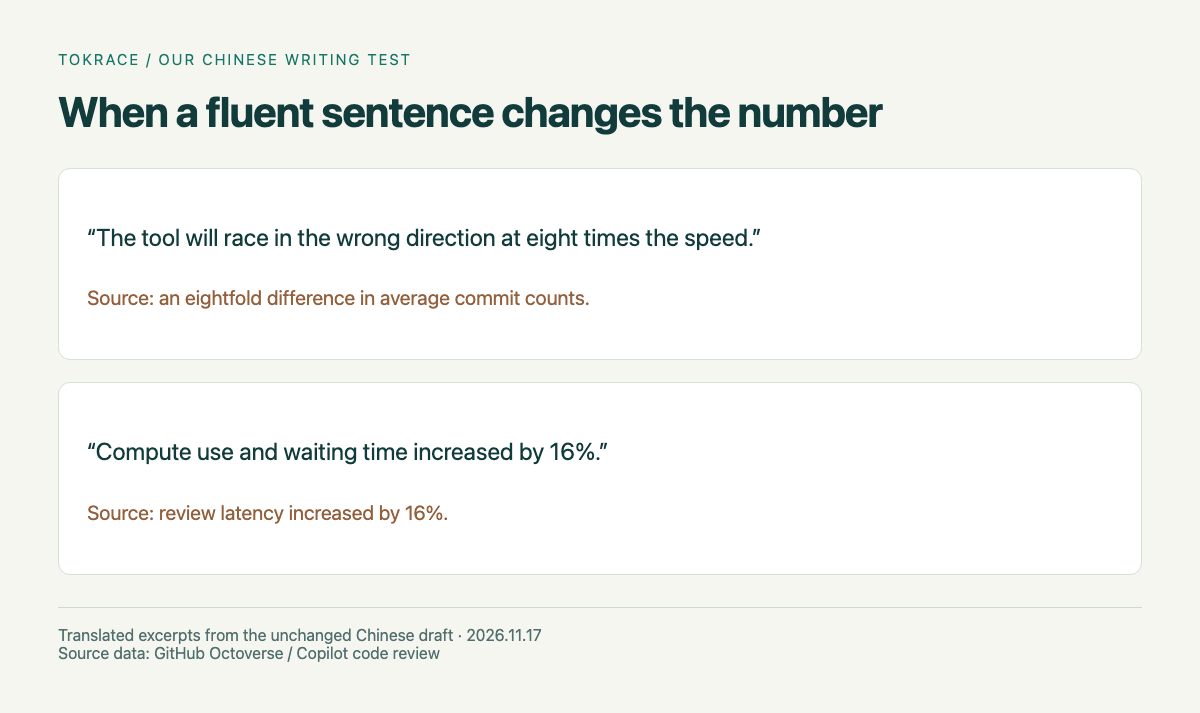
GitHub Octoverse reports a ratio of average commit counts between two groups of new repositories. Hydrogen turns that into a claim about racing in the wrong direction at eight times the speed. Another passage extends a 16% increase in review latency from Copilot code review to compute use as well.
At about 3,930 Chinese characters, the body exceeds the requested 2,600–3,400. It works as sourced industry analysis: a clear thesis and mechanisms, with fewer continuous accounts of company decisions. A reported feature also needs choices, disagreements and consequences, supported by interviews and company material.
Profile: a real choice carries the story
The profile begins with a concrete choice by Simon Willison: he lets models build much of his blog’s backend while writing the articles published under his name himself. Those actions establish tension around tools and authorship.
The model builds from that choice without inventing an interview exchange or a scene. It finds a position inside an action, making a more compelling opening than a résumé. The body is about 1,731 Chinese characters, within the requested 1,600–2,200.
The later paragraphs move toward agentic engineering and testing methods. Character-driven action becomes less frequent. The most useful edit would bring in further decisions and their consequences, keeping the person at the center.
Opinion: conviction needs a strong opposing argument
The opinion essay rejects commit counts as an engineering performance measure and proposes reliability, recovery time and reduced rework instead. At about 1,261 Chinese characters, it stays within the requested length and returns to a clear management choice.
Its weakest part is the opposing argument. The draft largely portrays the other side as seeking more output, making “more commits do not equal more value” an easy reply. A harder challenge is equal quality with faster delivery: how should a team value that advantage? Answering it would make the argument substantially stronger.
After natural prose comes the cost of editing
The useful strengths are specific: character openings, emails, short copy and local rewrites can benefit from Hydrogen’s detail and voice. Articles spanning studies, dates and a sustained argument still demand checks on units, statistical populations and the strength of conclusions.
A striking first impression favors the elegant sentence that turns eight times the commits into eight times the speed. Someone preparing to publish asks further questions: how long did factual corrections take, how much structure needed rebuilding, and how strong is the argument after its loudest rhetoric is removed?
Natural prose makes a model a more useful writing partner. The next expectation is steady command of facts: write the dry umbrella well, then remember throughout the article which events actually happened and which merely made a sentence flow.
Sources
Google: Introducing Gemini 4 Hydrogen
NovelThread: Gemini 4 Hydrogen for Fiction: Skip Medium, and Watch the Price
Reddit / WritingWithAI: Is it just me or is Gemini Hydrogen actually really good?
AI Writing Benchmark / Johannes Eva: ChatGPT or Gemini for writing in English?
Every Frontier / Dan Shipper: Gemini 4 Hydrogen Edits Sentences, Not Stories
Babbily: Gemini 4 Hydrogen, and Auto puts it to work
GitHub: Octoverse: Commits, pushes, reach new highs in 2026 as developers build with agents